
The root of happiness: does the distribution of trees in an area predict life satisfaction?


Hello everyone,
Hope you had a wonderful break.
Here is a short bonus post I planned to share prior to Christmas, but the results were less festive than expected so I could only bring myself to wrap it up this week.
Over the Christmas break and I was fortunate to be able to spent time with my parents who live in leafy South West London. Spending the last few days surrounded by greenery got me thinking about nature and it’s impact on life satisfaction.
Earlier this year, the Woodland Trust started an open data collaboration project with American Forests and the Centre for Sustainable Healthcare to track the amount of trees in different areas of the UK (and the US). The project resulted in a fascinating dataset called the “Tree Equity Score” which tracks the differences in regional tree coverage across the UK. The score is a function of the level of tree canopy cover relative to the “need for trees” and the “priority level” for the area which is based on a range of health and demographic prioritisation factors. The scores range from 0 to 100, where 0 indicates a high need for more trees in the area (under-coverage) and 100 indicates the highest possible tree coverage relative to need.
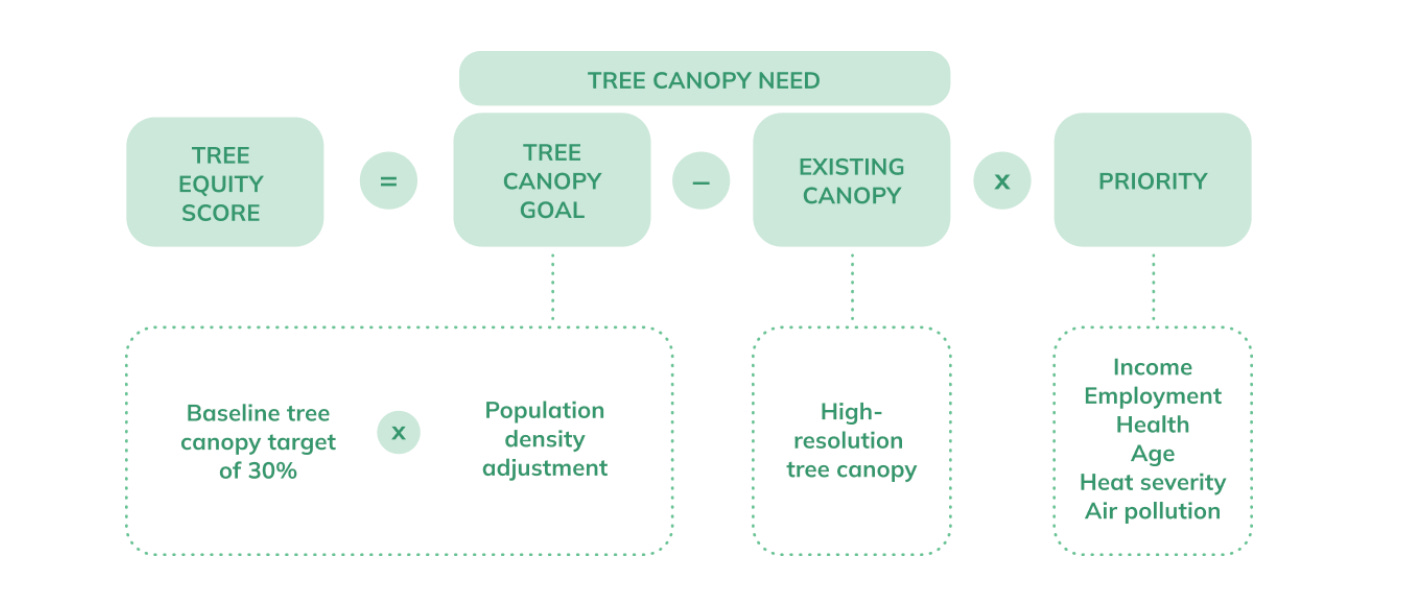
It’s a really fascinating piece of work and you can see the data for your area here.
The full data set is available to download for free - and I don’t need any excuse to run some analysis - so I linked the tree equity scores with income data and life satisfaction data by LA (from the ONS) and household deprivation indices (from the Census). The aim was to see if trees make us happier when controlling for income-related factors.
There are results were a bit mixed.
First - the use of the word “equity” when scoring tree coverage is fair. Trees are not very equally spread. In general, areas which are more well off have more trees (relative to their need) than areas that have lower incomes. Similarly, areas which have higher levels of deprivation have fewer trees (relative to their needs). The relationships are pretty clear when you simply graph the data:
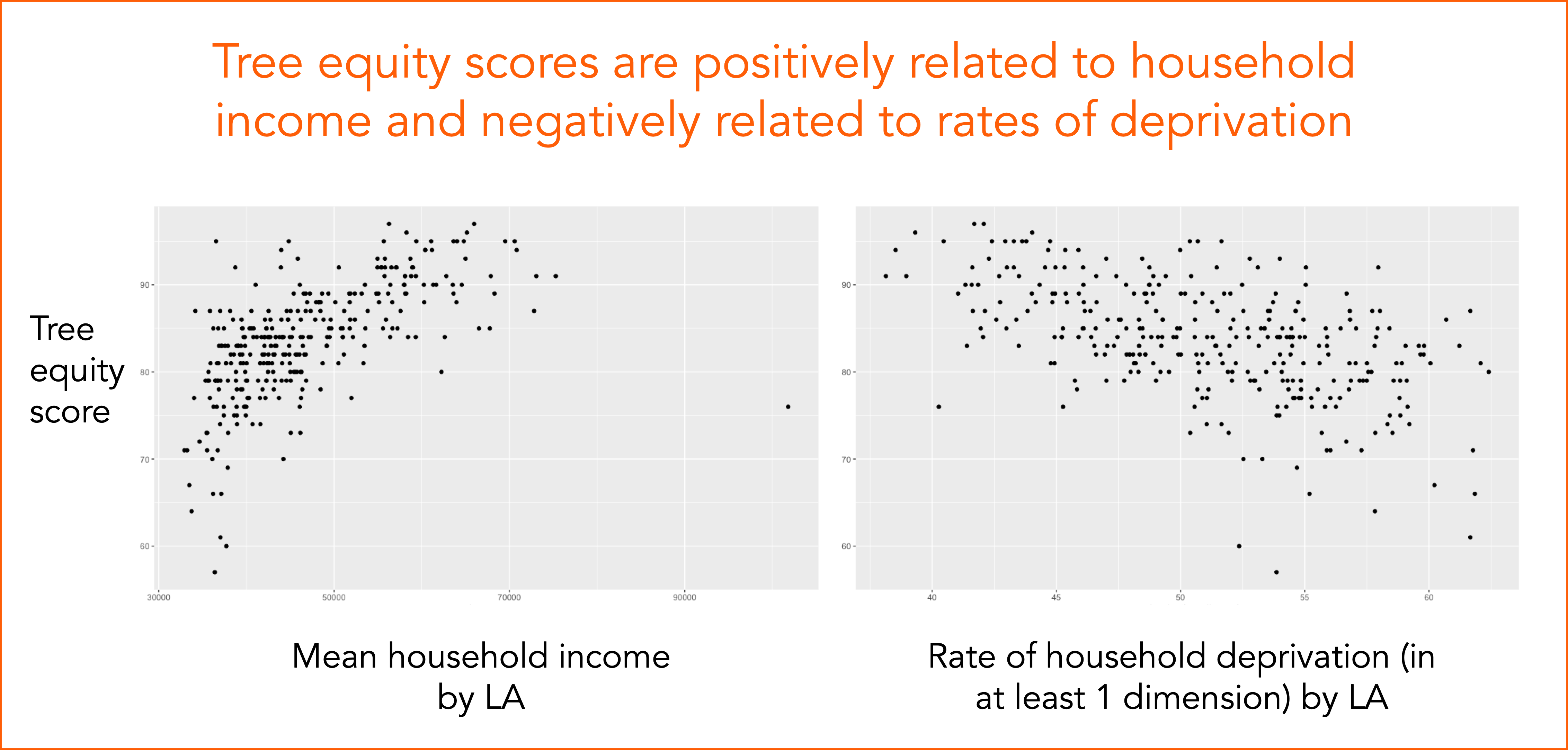
Second, when you run a regression of life satisfaction against income, deprivation and tree equity scores you find that:
As deprivation rises in an area, life satisfaction in that area falls - significant to the 1% level
As income rises in an area (controlling for deprivation), life satisfaction falls - significant to the 5% level
Having more trees in an area (controlling for income and deprivation) has no impact on life satisfaction
Income and deprivation vary with each other, and as we’ve seen tree equity varies with both of these variable. So my interpretation is:
Deprivation impacts life satisfaction negatively (not very surprising)
Higher income positively impacts your life satisfaction by lowering deprivation, but when you control for deprivation it negatively impacts life satisfaction; e.g., after a certain income threshold, having a higher paid job doesn’t increase your satisfaction. (I found this a little surprising)
Associations between Tree equity & life satisfaction are not significant when you control for income and deprivation. This suggest that while trees may make you more satisfied, income and deprivation are much stronger underlying drivers of the satisfaction scores. It also implies that tree coverage does not provide much explanatory power beyond income and deprivation, which in turn implies that tree equity is really (maybe unsurprisingly) an issue about socio-economic inequity
So not quite the warm, fuzzy Christmas result I expected but interesting nevertheless.
Part of the challenge with this kind of impact assessment is that access to nature is so unequal, which obscures the ability to measure it’s impact on our satisfaction. Crucially, if we can de-couple tree equity scores more from income & deprivation levels, we will get a much better view of how trees impact our happiness. Yet another reason to continue investing in areas that are underserved by their access to trees.
The Tree Equity Score project and the Woodland Trust are hoping that this data will result in more trees being planted in areas with highest need.
P.S. If any economists or data scientists are reading this - I think the tree equity score data has some interesting potential as an instrumental variable.